

Touchless Order Management at a Hi-Tech Manufacturer — 30+ Applications, 95% First-Touch Resolution
Workflow Automator + Multi-Agent Orchestrator unifying order processing across 30+ applications and 12 screens into a single automated workflow.
MindMap OS · installed inside the customer's perimeter by forward deployed engineers · Private Cloud · billed on the result
The challenge
The client — a global hi-tech manufacturer with a complex product portfolio spanning hardware components, embedded software licences, services subscriptions and post-sales support — was running an order-management workflow that the head of order operations described as a screen-toggling marathon. A single customer order required the order-processing agent to query, validate or update information across thirty-plus applications: the CRM for the customer profile, the product catalogue for the SKU configurations, the pricing tool for the contracted pricing, the credit system for the credit-line check, the inventory system for the stock position, the shipping system for the logistics quote, the ERP for the order posting, and another two dozen specialist systems for the per-product-type validations.
The mechanical reality was that the agents toggled between an average of twelve screens per order. Information-aggregation activities (pulling data from one system to validate against data in another) dominated the agent's time; the genuine order-handling decision-work (the exception cases, the customer-relationship judgements) was crowded out by the keying-and-toggling burden. Errors compounded: a mistyped customer reference number in one system would propagate through the order with the wrong pricing or the wrong shipping address, requiring downstream correction work.
The head of operations had specific targets. Operational efficiency was the headline objective; the manufacturer's competitors had visibly faster order-to-shipment cycle times and the gap was beginning to influence customer-relationship outcomes on the strategic accounts. The constraint was that the manufacturer's IT investment did not support a wholesale application-platform consolidation programme — the workflow needed to be improved against the existing application estate.
The approach
MindMap deployed an order-management automation platform composed of Workflow Automator (Wa) as the screen-level orchestration layer, Multi-Agent Orchestrator (Mo) for the cross-application workflow coordination, DocuMage (Dm) for the unstructured-input handling (the email-based order-amendment requests), and Anomaly Detector (Ad) for the order-validation-and-error-detection workflow.
Phase one was the application-and-screen mapping. We catalogued every application touched by the order-management workflow, the specific screens within each application used by the agents, the data fields read and written per screen, and the inter-application data dependencies (which fields in one system inform which fields in another). The catalogue identified the automation opportunities and the residual judgement-points where human decision-making remained essential.
Phase two was the touchless-order-workflow build. Workflow Automator orchestrated the cross-application data-aggregation work — pulling the customer profile from the CRM, the product configuration from the catalogue, the pricing from the pricing tool, the credit position from the credit system, the inventory position from the inventory system, the logistics options from the shipping system. Multi-Agent Orchestrator coordinated the per-order workflow with parallel-task execution where data-dependencies permitted, with the aggregated data assembled into a structured order-validation-and-posting payload.
Phase three was the exception-handling and human-in-loop integration. Orders that passed every validation flowed through to ERP posting without human touch; orders with validation failures or with customer-relationship-sensitive considerations routed to a unified exception-handling UI where the agent worked the order through with full context (the validation result, the relevant data from each contributing system, the customer's recent order history) presented in a single screen rather than across twelve.
Phase four was the unstructured-input handling layer. Email-based order amendments and customer-correspondence routed through DocGenie's extraction-and-classification workflow, with the extracted data integrated into the appropriate order-workflow step rather than requiring the agent to manually transcribe the email content into the workflow.
The pre-built building blocks
Rather than commission a ground-up build, the engagement leaned on MindMap's pre-built accelerator library — production-tested components that compress what would otherwise be a six-to-nine-month build into weeks.
The architecture
The platform runs on the manufacturer's private cloud environment with per-region deployment to satisfy the manufacturer's data-residency commitments across its markets. The cross-application orchestration runs against the manufacturer's existing application estate without requiring application-platform changes.
Workflow Automator's screen-level orchestration uses a combination of API-level integration where available (the modern applications expose well-defined REST APIs), GUI-level automation where APIs are not available (the legacy applications), and EDI/messaging integration where supported. The integration approach is selected per application based on the integration-capability inventory; the platform abstracts the integration mechanism behind a uniform data-access layer.
Multi-Agent Orchestrator coordinates the per-order workflow as a graph of cross-application tasks with the per-task dependency-aware orchestration. The orchestrator handles the parallel-execution where the application-data dependencies permit (the customer-profile lookup, the inventory-position check and the credit-line check can run in parallel) and the serial-execution where they require (the pricing-validation depends on the customer-profile and the product-configuration both being resolved first).
DocGenie's unstructured-input handling combines email-classification (identifying the email as an order-related communication versus a non-order communication), intent-classification (identifying the order-amendment intent — quantity change, shipping-address change, expedite-request, cancellation), and structured-extraction (extracting the specific amendment-data fields from the email content). The classification confidence drives the workflow path — high-confidence emails flow into the automated amendment-workflow, low-confidence emails route to the agent's exception queue.
Anomaly Detector runs the order-validation-and-error-detection workflow. Detection rules include consistency checks across the contributing-application data (the customer-profile in the CRM should match the customer-profile on the order), business-rule checks (the pricing should match the customer's contracted pricing), and pattern-checks (the order should not match a known fraudulent-order pattern).
Reporting-and-management dashboards provide the per-day order-volume statistics, the per-order-type processing-metrics and the exception-and-error trend analysis. The audit trail captures every order-lifecycle event with the full context preserved.
The numbers behind the story
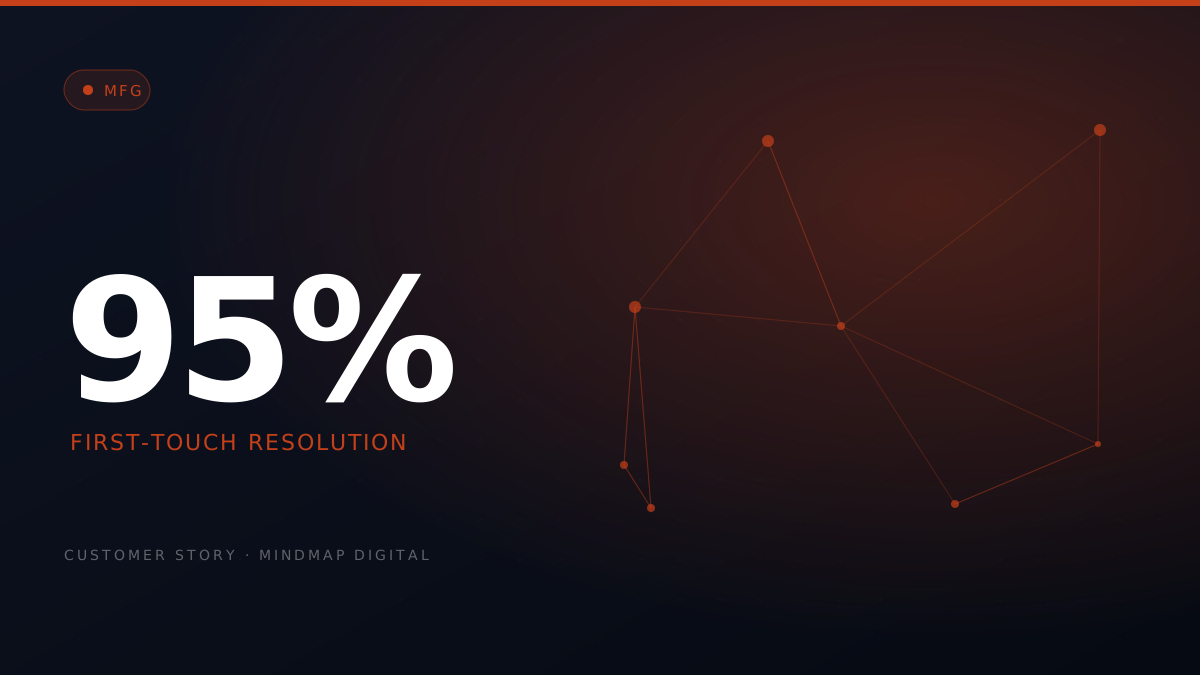
First-touch-resolution on automated orders has stabilised at 95% — the order flows from the customer-submission through ERP-posting and shipment-initiation without requiring any human touch beyond the initial submission. The 5% exception rate routes to the unified exception-handling UI where the agent resolves the case with full context in a single screen rather than across the previous twelve.
Overall order-completion cycle time has reduced 25% against the pre-automation baseline. The cycle-time reduction is dominated by the elimination of the cross-application keying-and-toggling burden; the genuine processing-time (the inter-system data-availability latency, the customer-acceptance-of-confirmation lag) accounts for the bulk of the residual cycle time.
Annual run-rate savings have reached approximately $90K for the customer at the operational scale of the engagement, with payback achieved well within the first year and incremental ROI accruing as the order-volume continues to grow on the same automated foundation.
Agent capacity has been redirected to higher-value work. The agents who previously spent the bulk of their day on the keying-and-toggling work are now focused on the customer-relationship-management work (the strategic-account engagement, the customer-success follow-ups, the exception-cases that genuinely require judgement) that the previous workload had crowded out.
An unexpected outcome: the platform's data-aggregation layer has surfaced data-quality issues across the manufacturer's application estate that had been invisible in the manually-orchestrated workflow. The customer-profile inconsistencies across the CRM and the ERP, the pricing-data mismatches across the pricing tool and the contract repository, and the inventory-data drifts across the inventory system and the warehouse-management system have all been surfaced for the data-governance team's remediation work.
“Our order-management agents were spending their day toggling between twelve screens across thirty-plus applications. MindMap built a touchless workflow that delivered ninety-five per cent first-touch resolution and twenty-five per cent cycle-time reduction without requiring the application-replacement programme our alternatives proposed. Our agents are working customer relationships now, not keying.”— Head of Order Operations· Hi-Tech Manufacturer
Why MindMap was chosen
The manufacturer had evaluated two specialist order-management automation vendors. Both proposed application-replacement programmes that would have required wholesale migration to a unified order-management platform. The manufacturer's CIO concluded that the application-replacement approach was incompatible with the IT investment cycle and the operational-disruption tolerance.
MindMap's accelerator-composition approach — bringing Workflow Automator, Multi-Agent Orchestrator, DocGenie and Anomaly Detector together around the existing application estate rather than replacing it — was the structural differentiator. We delivered the first automated-workflow tranche within twelve weeks and the full order-management automation within twenty-eight weeks, against the alternatives' multi-year horizons.
Our embedded order-operations expertise on the delivery team (two former hi-tech-manufacturer order-operations leads and a former ERP-implementation lead with cross-application integration experience) was the third factor. The manufacturer's head of operations felt that the team understood the operational reality of a complex multi-application order-management workflow.
Get the MindMap capability deck
The platform, the accelerator library and how an engagement runs, in one deck. Our team emails it within one business day.
Related deployments
Demand Forecasting + AP Automation
Demand Forecaster across 8,000 SKUs cut inventory 18% while improving service levels; AP Automation cut invoice TAT from 14 days to under 48 hours.
Predictive Maintenance
Production Line Monitor + Anomaly Detector cut unplanned downtime by 38% across 14 plants — through predictive maintenance on the critical asset base.
Quality Control AI
Inline computer-vision QC on 14 production lines — 96% defect-detection accuracy, with downstream rework reduced 71%.
Want an outcome like this?
Start with a 2-week AI Readiness Sprint. We deliver a prioritised use-case backlog and business case grounded in what's actually buildable with our accelerator library.