

Customer Billing Dispute Automation at a UK Energy Utility — 78% of Disputes Resolved Same-Day
ChatNext + DocuMage + Multi-Agent Orchestrator collapsing the billing-dispute resolution cycle from weeks to hours.
MindMap OS · installed inside the customer's perimeter by forward deployed engineers · Private Cloud · billed on the result
The challenge
The utility — a UK energy utility (combined electricity-and-gas-supplier) with approximately 5.2 million customer accounts — was operating under intense regulatory and reputational pressure on customer service, with billing-dispute resolution being one of the most-cited customer-experience pain points. Average billing-dispute resolution time was 11-18 working days depending on dispute category, with the longer-cycle disputes (those involving metering issues, supplier-switching disputes, or backbilling cases) routinely taking 4-8 weeks to reach final resolution.
The Ofgem consumer-standards framework had been progressively tightening expectations on supplier responsiveness, with several recent enforcement actions against UK suppliers for poor dispute-handling. The utility's leadership had been under direct regulatory pressure to improve dispute-resolution performance, with the consumer-affairs team specifically tasked with reducing dispute-resolution-cycle-time and dispute-related complaint volume.
The constraints were operational. The utility's existing billing-and-CRM systems could not be replaced (a multi-year platform-migration was already in progress and could not be disrupted). The customer-data handling required GDPR compliance and the Ofgem-specific consumer-data-handling requirements. The customer-service team — approximately 1,800 staff across multiple contact-centres — had a healthy scepticism of AI-driven dispute-handling after previous chatbot work that had handled FAQ-style queries but had been unable to actually resolve disputes.
The approach
MindMap deployed a billing-dispute platform composed of ChatNext (Cn) as the customer-conversational interface, DocuMage as the document-intelligence layer (for the customer-submitted documentary evidence — meter photos, smart-meter data exports, supporting bills, switching documentation), Multi-Agent Orchestrator (Mo) as the dispute-resolution workflow coordinator, and Compliance Engine (Ce) for the Ofgem-consumer-standards rules enforcement.
Phase one was the dispute-taxonomy and resolution-rule build. The utility's billing-dispute history was analysed to produce a structured dispute-taxonomy — approximately 240 distinct dispute categories with associated resolution-criteria, evidence-requirements and Ofgem-consumer-standards constraints. The Compliance Engine encodes the Ofgem-rules-and-supplier-licence-conditions as deterministic rules; the resolution-criteria are evaluated against the documentary evidence the customer provides.
Phase two was the customer-conversational interface. Customers raising disputes through the utility's website, mobile app, WhatsApp or contact-centre interact with the ChatNext-based dispute-handling conversation. The conversation walks the customer through the dispute-context capture, the documentary-evidence collection (with on-the-spot DocuMage analysis of submitted documents), and the dispute-resolution path.
Phase three was the resolution-orchestration layer. For each dispute, the Multi-Agent Orchestrator dispatches the relevant resolution-tasks in parallel — the meter-reading validation against the utility's smart-meter-data feed, the tariff-application validation against the billing-engine, the switching-history validation against the central-switching-platform, the prior-correspondence retrieval from the utility's CRM. The orchestrator assembles the resolution-outcome based on the parallel-task outcomes.
Phase four was the human-handoff layer. For disputes that exceed the platform's capability — disputes requiring specialist judgement, disputes with vulnerable-customer indicators, disputes involving multi-party complexity — the platform hands off to the appropriate human agent with full case-context preserved.
The pre-built building blocks
Rather than commission a ground-up build, the engagement leaned on MindMap's pre-built accelerator library — production-tested components that compress what would otherwise be a six-to-nine-month build into weeks.
The architecture
The platform runs on the utility's Azure tenant in the UK region with full GDPR and Ofgem-consumer-data-handling compliance. The customer-data processing happens inside the utility's perimeter with appropriate access-controls.
ChatNext's conversational engine uses a fine-tuned Llama 3.1 70B variant trained on the utility's historical dispute-handling corpus (with appropriate PII redaction). The model handles the empathetic-but-accurate dispute-handling conversation tone the utility's customer-experience leadership has defined, with hallucination guardrails preventing the model from making commitments outside the utility's defined response framework.
DocuMage's customer-document analysis handles the meter photos (extracting the meter reading with on-image validation), the smart-meter-data exports (validating the customer's data against the utility's smart-meter feed), the supporting bills (extracting the relevant billing-period and consumption data), and the switching documentation (extracting the relevant switching-event details).
Multi-Agent Orchestrator handles the dispute-resolution workflow with parallel-task orchestration across the utility's source systems — the billing engine, the smart-meter-data feed, the central-switching-platform, the CRM correspondence repository. The orchestrator's tasks complete within minutes for most disputes, with the resolution-outcome assembled and presented to the customer in the same conversation.
Compliance Engine enforces the Ofgem-consumer-standards rules — the response-time requirements, the customer-rights-preservation requirements, the vulnerable-customer-handling requirements — as deterministic gates on the resolution outcomes. The audit trail captures every dispute-decision with the supporting evidence and the regulatory-compliance assessment.
Integration with the utility's billing-and-CRM systems uses the systems' standard inbound APIs, with the platform sitting upstream of the existing systems rather than replacing them.
The numbers behind the story
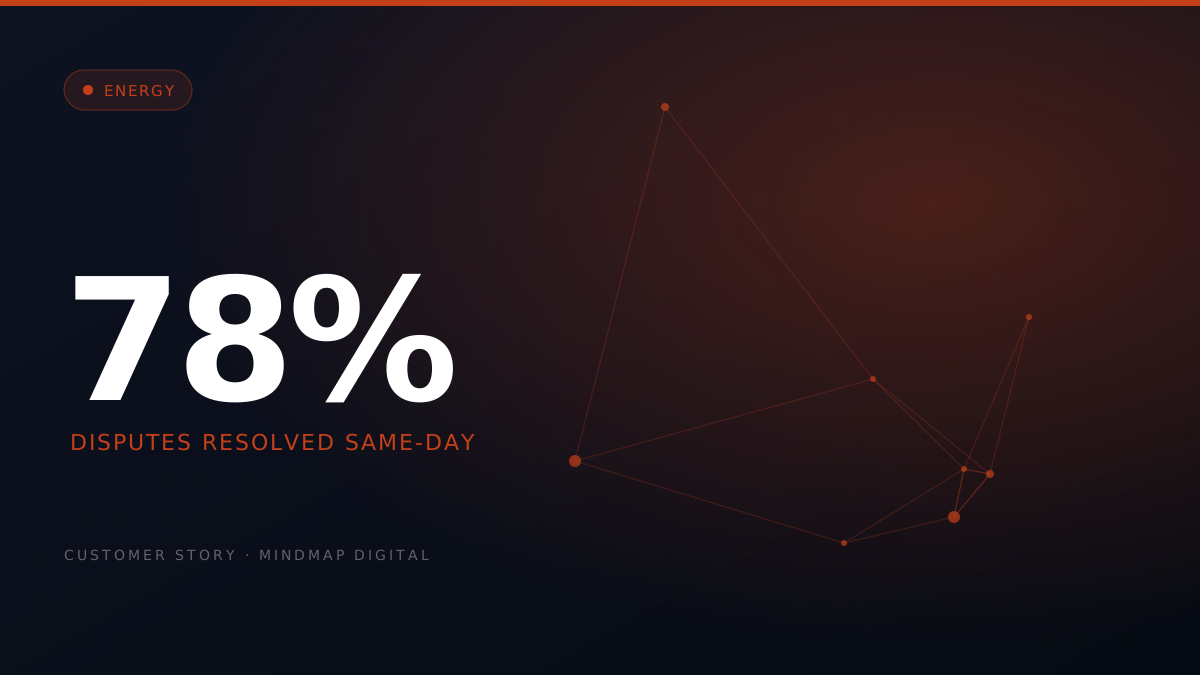
Approximately 78% of billing disputes are now resolved same-day through the platform — meaning the customer initiates the dispute conversation, the platform assembles the resolution-outcome through the parallel-task orchestration, and the customer receives the resolution within the same conversation. The 78% same-day resolution rate represents a substantial inversion of the previous customer-experience pattern.
Dispute-related complaint volume has dropped approximately 84%. The earlier-and-faster resolution combined with the explicit resolution-rationale (the customer receives a structured explanation of the resolution decision with the relevant evidence cited) has materially reduced the escalation-to-complaint rate.
Ofgem-consumer-standards alignment has been maintained throughout. The Compliance Engine's deterministic rule-enforcement ensures the platform's dispute-handling complies with the relevant standards. The utility's regulatory engagements on the dispute-handling topic have moved from defensive-and-reactive to constructive-and-collaborative.
Customer-service workforce has been redirected rather than reduced. The platform handles the high-volume routine disputes that had been absorbing the bulk of the workforce capacity; the workforce has been redirected to the complex-dispute handling, the vulnerable-customer engagement and the dispute-prevention work that the previous workload had crowded out. Customer-experience metrics on the human-handled disputes have improved correspondingly.
An unexpected outcome: the dispute-pattern analytics has surfaced systemic billing-issues that the utility's billing-and-operations teams had not previously been able to identify systematically. Several billing-engine configuration issues, several tariff-application edge cases and several meter-reading-validation issues have been resolved through the platform's pattern-detection insights, with material reduction in the downstream dispute-volume on the affected issue-categories.
“We were under intense Ofgem pressure on dispute-resolution and customer-service performance. MindMap delivered seventy-eight per cent same-day dispute-resolution in twenty-six weeks, with eighty-four per cent reduction in dispute-related complaints and Ofgem-consumer-standards compliance by construction. Our regulatory engagements have moved from defensive to constructive, and our customer-service workforce is doing the complex-and-vulnerable-customer work that genuinely needs human attention.”— Customer Affairs Director· UK Energy Utility
Why MindMap was chosen
The utility had evaluated two UK-CRM-specialist vendors. Both had strong customer-service-workflow capabilities but limited LLM-driven dispute-resolution depth and limited DocuMage-equivalent document-intelligence capability.
MindMap's accelerator-composition approach — bringing ChatNext, DocuMage, Multi-Agent Orchestrator and Compliance Engine together with the augmentation-pattern integration with the utility's existing billing-and-CRM systems and the Ofgem-consumer-standards-by-design approach — was the structural differentiator.
Our embedded UK utility expertise on the delivery team (two former customer-service directors from peer UK energy utilities and a former Ofgem consumer-affairs analyst) was the third factor. The utility's customer-affairs director felt that the team understood the regulatory and operational reality of UK utility dispute-handling.
Get the MindMap capability deck
The platform, the accelerator library and how an engagement runs, in one deck. Our team emails it within one business day.
Related deployments
Grid Demand Forecasting
Demand Forecaster delivered 4% MAPE on day-ahead grid demand — driving 18% lower system-balancing cost in a renewables-dominated grid.
UK Challenger Bank KYC
OnboardX rebuilt the KYC pipeline with liveness, sanctions and PEP enrichment in a single STP flow, collapsing onboarding from 5 days to 4 hours.
Motor Claims Automation
Claims Router + DocuMage automated 80% of low-complexity motor claims to same-day settlement, with FCA-grade explainability on every decision.
Want an outcome like this?
Start with a 2-week AI Readiness Sprint. We deliver a prioritised use-case backlog and business case grounded in what's actually buildable with our accelerator library.