

Real-Time Budget Variance Platform at a Global IT Services Provider — 2.5% Margin Impact, 4-5x ROI in 3 Quarters
FP&A Insights + Workflow Planner + Compliance Engine transforming budget management from a backward-looking exercise into a real-time spend-decision engine with predictive exhaustion alerts.
MindMap OS · installed inside the customer's perimeter by forward deployed engineers · Managed Cloud · billed on the result
The challenge
The same client — having delivered the FP&A reporting transformation — turned attention to the budget-management function, which had remained on a manually-orchestrated approval-driven model. Budget planning happened annually at the cost-element level rolled up through a hierarchy that ended at the vertical-level P&L. Variance tracking was an after-the-fact monthly exercise; by the time the variance was visible in the MIS, the spend had already happened and the corrective action was a difficult conversation rather than a preventive one.
Two structural symptoms motivated the engagement. Exception budget approvals for non-operational expenditure (the formal approval route for any spend that exceeded the approved budget envelope) were running at 25% of total non-operational spend, indicating that the budgeting exercise itself was not predictive enough of actual spend. And cost leakages — spend categories where the spend was happening but no manager had clear accountability or visibility — were absorbing margin that nobody was actively managing.
The CFO's brief was to convert budget management from a backward-looking control to a real-time decision-engine, with predictive consumption alerts ahead of budget exhaustion and indenting-system integration that prevented new commitments where budgets were already overrun. The condition was that the platform had to work with the existing finance-operating-model and not require a structural change to the approval-workflow culture.
The approach
MindMap deployed a budget-management platform composed of FP&A Forecaster (Ff) as the analytics layer, Workflow Planner (Wp) for the predictive-consumption modelling, Compliance Engine (Ce) for the budget-rule enforcement, and Workflow Automator (Wa) for the indenting-system integration where APIs were not available.
Phase one was the budgeting-tool design. We built a web-based budgeting interface that supported budget planning at the lowest element-level (the cost-element at the project-and-employee level) with automatic roll-up through the hierarchy. The tool integrated with the group's existing user-roles-and-workflow framework, replicating the existing approval flows rather than disrupting them, so the rollout did not require a process-change-management programme alongside the platform implementation.
Phase two was the real-time cost-tracking integration. The master data table from the FP&A reporting platform was extended with a real-time backflow from the group's primary ERP, capturing every cost-posting as it happened with the appropriate project-and-cost-element tagging. The budgeting tool displays the real-time consumption against the planned budget through gauge-based visualisations and includes drill-down to the underlying cost transactions for variance investigation.
Phase three was the early-warning mechanism. Threshold levels are configured per cost-element type (a more conservative threshold for travel-and-discretionary categories, a more permissive threshold for project-direct-cost categories) with the alerts routed to the relevant budget-manager and their hierarchy. The predictive-consumption modelling uses the historical-consumption pattern, the project-milestone schedule and any planned-commitment data (planned travel, planned hiring) to forecast when the budget will exhaust under current run-rate.
Phase four was the indenting-system integration. The platform integrates with the group's manpower-request, travel-request and procurement-request systems to perform real-time budget-availability checks before new commitments are raised. Where a budget is exhausted, the indenting system blocks the new request with a clear explanation; where the budget is approaching the threshold, the request raises a soft warning routed to the budget-manager for approval.
The pre-built building blocks
Rather than commission a ground-up build, the engagement leaned on MindMap's pre-built accelerator library — production-tested components that compress what would otherwise be a six-to-nine-month build into weeks.
FP&A Forecaster
Budgeting-interface and real-time variance analytics
Workflow Planner →
Predictive budget-consumption modelling
Compliance Engine →
Budget-rule and exception-routing enforcement
Workflow Automator →
Indenting-system integration for real-time availability checks
The architecture
The platform runs on the group's managed cloud tenant alongside the FP&A reporting platform and shares the master data table as the single source of truth for cost data. The budget-planning data is held in a dedicated budget master table linked to the cost master through the shared unique-key model (project code, employee code, cost element).
FP&A Insights' budgeting-tool interface is built as a web application with the front-end visualisations rendered through QlikView's embedded components. The interface supports real-time interactive variance analysis with one-click drill-down from the budget-summary level to the individual-transaction level. Report downloads in standard formats support the offline analytical work.
Workflow Planner runs the predictive-consumption modelling. The model is per-budget-element (a separate model per cost-element-and-project combination) with the model selection driven by the historical-data depth available; cost-elements with multi-year history use ARIMA-style time-series models, while elements with limited history use the group-level seasonality patterns with element-specific adjustments. The model produces a consumption-forecast with confidence intervals and a budget-exhaustion-date prediction.
Compliance Engine encodes the group's budget-rule library — threshold definitions per cost-element-type, exception-approval-routing rules, escalation-trigger rules and the cross-budget-rebalancing constraints. The engine evaluates the indenting-system requests against the relevant rules and produces the allow / warn / block outcomes.
Workflow Automator handles the integration with the indenting systems where direct API integration was not available. The RPA workers run inline with the indenting-request workflow with sub-second response times that do not visibly slow the user-facing request submission.
The audit trail captures every budget-related decision (planning, approvals, real-time-consumption snapshots, threshold-alert generations, indenting-system block/warn outcomes) with the full context preserved.
The numbers behind the story
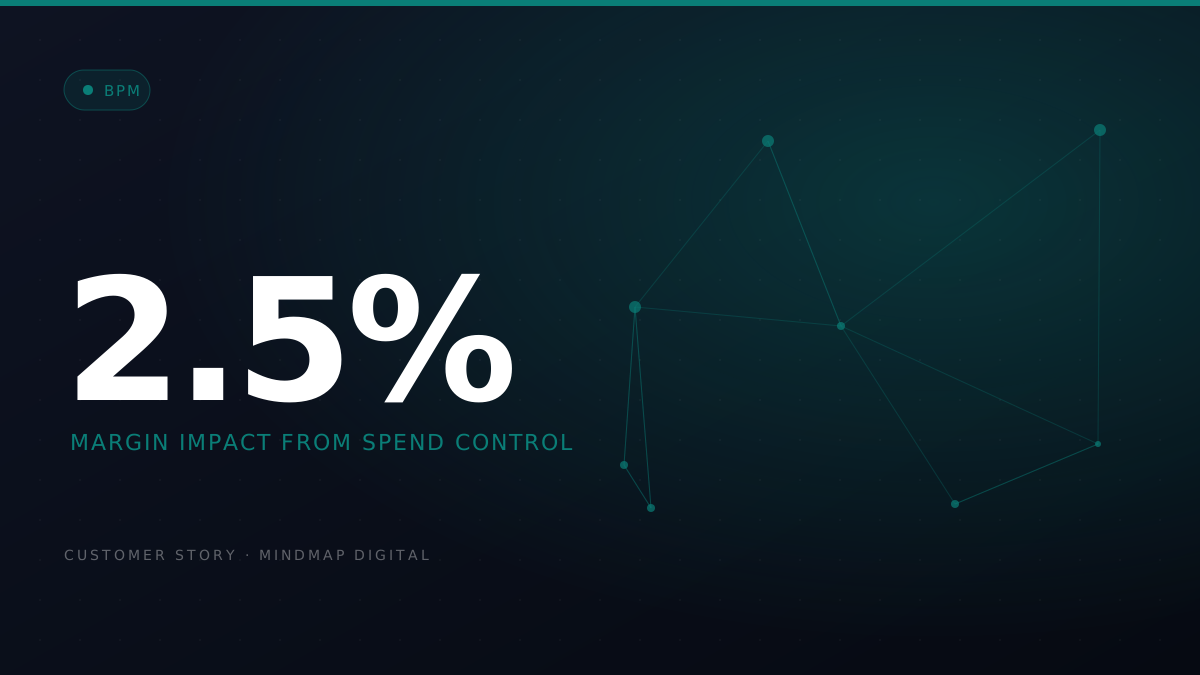
Exception budget approvals for non-operational expenditure have dropped from 25% to 5%, a reduction of 20 percentage points that translates into approximately 2.5% direct margin impact for the group. The reduction reflects both more accurate upfront budgeting (driven by the visibility into real-time consumption patterns) and effective preventive controls at the indenting-system level (the early-warning mechanism produces reallocation conversations before the spend happens rather than approval-conversations after the fact).
Cost leakage identification has produced an additional 0.3% margin impact. The drill-down facility has allowed project managers to identify dead-cost categories that had been absorbing spend without active management; the platform's analytics surfaces these on a per-project basis with the supporting transaction context, enabling rapid corrective action.
Budget-exhaustion alerts have produced agile fund-allocation responses. Where the predictive model identifies an approaching exhaustion on a high-priority cost-element, the budget-management workflow now routes the reallocation conversation early enough to support business-need rather than constrain it; the alternative scenario (running out of budget mid-quarter and stopping the activity) has largely been eliminated.
The platform delivered approximately 4-5x ROI within three quarters of implementation, against the platform-implementation cost. The ROI calculation includes the direct margin impact, the cost-leakage recovery, and the headcount-redirection benefit from the previously-required exception-approval workflow.
An unexpected outcome: the predictive-consumption modelling has supported the group's quarterly forecasting process. The group's CFO now uses the platform's aggregated consumption forecast as the primary input to the quarterly cost-base forecast, replacing the previous manual aggregation of regional cost-base submissions.
“Our budget management had been an after-the-fact control rather than a real-time decision-engine. MindMap converted it into a platform that prevents the overspend conversation from being needed in the first place — a two-and-a-half per cent margin impact with four-to-five times ROI in three quarters, and our quarterly cost-base forecast is now driven by the platform's predictive consumption model rather than by manual aggregation.”— Group CFO· Global IT Services Provider
Why MindMap was chosen
The group considered an extension of the engagement with the same FP&A reporting partner that had been declined for the reporting work, and also evaluated a specialist EPM-platform vendor. The specialist vendor's pricing was structurally tied to enterprise-licence economics and did not accommodate the group's preference for outcome-linked commercials.
MindMap was selected based on the demonstrated delivery from the FP&A reporting engagement and the architectural alignment with the existing master data investment. The budget-management platform could be delivered as an extension of the existing platform rather than as a separate platform requiring its own integration-and-data-handling investment.
Our willingness to structure the engagement with the success-fee component tied to demonstrated margin-impact outcomes was the third factor. The CFO valued the alignment between the platform's commercial structure and the platform's intended business outcome.
Get the MindMap capability deck
The platform, the accelerator library and how an engagement runs, in one deck. Our team emails it within one business day.
Related deployments
Background Checks at Scale
A unified RPA + IDP stack handling identity, employment, education, criminal and credit checks across 40 countries — 3,000 checks per day, straight-through.
RPA-to-Agentic Migration
A migration from 38,000 brittle RPA bots to 240 agentic workflows — handling more volume at a fraction of the maintenance burden.
Big-4 AI Delivery Practice
MindMap's platform underpins the Big-4 firm's AI delivery practice — 2,400 consultants delivering AI engagements to the firm's enterprise customer base.
Want an outcome like this?
Start with a 2-week AI Readiness Sprint. We deliver a prioritised use-case backlog and business case grounded in what's actually buildable with our accelerator library.