

Citizen Services Chatbot at a Gulf Government Agency — 18 Service Domains, 7 Languages, Sovereign Deployment
ChatNext + Policy Q&A Agent + Multi-Channel Agent delivering unified citizen-services across the agency's full service portfolio.
MindMap OS · installed inside the customer's perimeter by forward deployed engineers · On-Premises · billed on the result
The challenge
The agency — a Gulf-region government agency responsible for the citizen-services portfolio across 18 distinct service domains (immigration-and-residency, business-licensing, healthcare-registration, education-records, social-services, taxation-interaction, vehicle-and-licensing, civil-registry, and others) — was operating citizen-services through a combination of physical service centres, a contact-centre operation and an aging website with limited service-coverage. The agency's leadership had set an ambitious target of transforming the citizen-services delivery to a digital-first model with the contact-centre and physical service-centres reserved for the cases that genuinely required them.
The previous attempts at digital citizen-services had been structurally limited by the depth of integration required. Each of the 18 service domains had its own back-end system, its own policy-and-procedure framework, its own language-and-terminology conventions. Generic chatbot deployments had handled the simple FAQ-style questions but had been unable to perform the actual service transactions that constituted the bulk of citizen-interaction volume.
The constraints were sovereign-deployment-led. The agency's data-handling posture required all citizen-data processing to happen inside the country's borders on infrastructure under the agency's direct control. The citizen-base spoke seven languages across the agency's footprint (Arabic, English, Urdu, Hindi, Tagalog, Bengali, Malayalam). The agency's accessibility-and-cultural-appropriateness requirements applied across all service-delivery channels.
The approach
MindMap deployed a citizen-services platform composed of ChatNext (Cn) as the conversational interface, Policy Q&A Agent (Pq) as the policy-and-procedure knowledge layer, Multi-Channel Agent (Mh) for the unified-channel delivery (web, mobile-app, WhatsApp, voice), Sovereign LLM Platform (Sl) for the on-premises model serving, and OnboardX (Ox) for the citizen-identity-verification layer.
Phase one was the per-service-domain build. Each of the 18 service domains received a per-domain build with the domain-specific policy-and-procedure knowledge base, the domain-specific back-end-system integration, and the domain-specific transaction flows. The platform's domain-architecture was designed to support consistent citizen-experience across the domains while accommodating the per-domain back-end-system variation.
Phase two was the cross-domain citizen-experience build. A citizen interacting with one service domain often has needs that span multiple domains (a residency-renewal transaction triggers vehicle-registration, healthcare-registration and business-licensing implications). The platform's cross-domain awareness surfaces the relevant cross-domain implications proactively, with the citizen able to handle multiple service-domain interactions in a single conversation.
Phase three was the language-and-accessibility build. The seven-language coverage required per-language fine-tuning on the agency's policy-and-procedure corpus (with the cultural-appropriateness considerations for each language community). The accessibility features included voice-input mode for citizens who prefer not to type, simplified-language mode for citizens with limited literacy, and full screen-reader support for visually-impaired citizens.
Phase four was the human-handoff layer. For interactions that exceed the platform's capability — complex multi-domain cases, exception cases requiring human judgement, citizen-complaints that need empathetic human handling — the platform hands off to the appropriate human agent with full conversation-context preserved and the structured-case-summary that allows the human agent to engage immediately.
The pre-built building blocks
Rather than commission a ground-up build, the engagement leaned on MindMap's pre-built accelerator library — production-tested components that compress what would otherwise be a six-to-nine-month build into weeks.
ChatNext →
Conversational interface across 18 service domains
Policy Q&A Agent →
Policy-and-procedure knowledge layer with per-domain libraries
Multi-Channel Agent →
Unified channel delivery across web, app, WhatsApp and voice
Sovereign LLM Platform →
On-prem Llama 3.1 and Mistral serving with per-language fine-tuning
OnboardX →
Citizen-identity-verification integration with national-ID infrastructure
The architecture
The platform runs entirely on the agency's on-premises infrastructure inside the agency's primary data centre, with active-active failover to the secondary site. No citizen data leaves the country's borders; the platform is air-gapped from the public internet for the citizen-data-processing components.
Sovereign LLM Platform serves Llama 3.1 70B-Instruct (for the complex multi-domain reasoning) and a smaller Mistral 7B model (for the high-volume simple interactions) on the agency's on-prem GPU cluster. The models are fine-tuned on the agency's policy-and-procedure corpus, with the per-language fine-tuning covering the seven required languages.
ChatNext's conversational engine handles the per-domain conversation flows, with the domain-routing layer determining which service domain (or cross-domain combination) the citizen's interaction requires. The conversation logic is constrained to the agency's defined service-and-policy framework, with hallucination guardrails preventing the model from inventing services or policies that do not exist.
Policy Q&A Agent provides the policy-and-procedure knowledge layer, with the per-domain policy library indexed for retrieval-augmented generation. The policy library is the system of record for the agency's policy interpretations, with updates flowing through the agency's standard policy-update workflow.
Multi-Channel Agent delivers the platform across the web portal, mobile app, WhatsApp Business and voice channel. Each channel uses the same underlying conversation-and-policy engine, ensuring consistent citizen-experience across the channels.
OnboardX handles the citizen-identity-verification layer using the agency's existing national-ID-verification infrastructure, with the platform's identity-verification gate ensuring that service transactions are performed only by the legitimate citizen.
The numbers behind the story
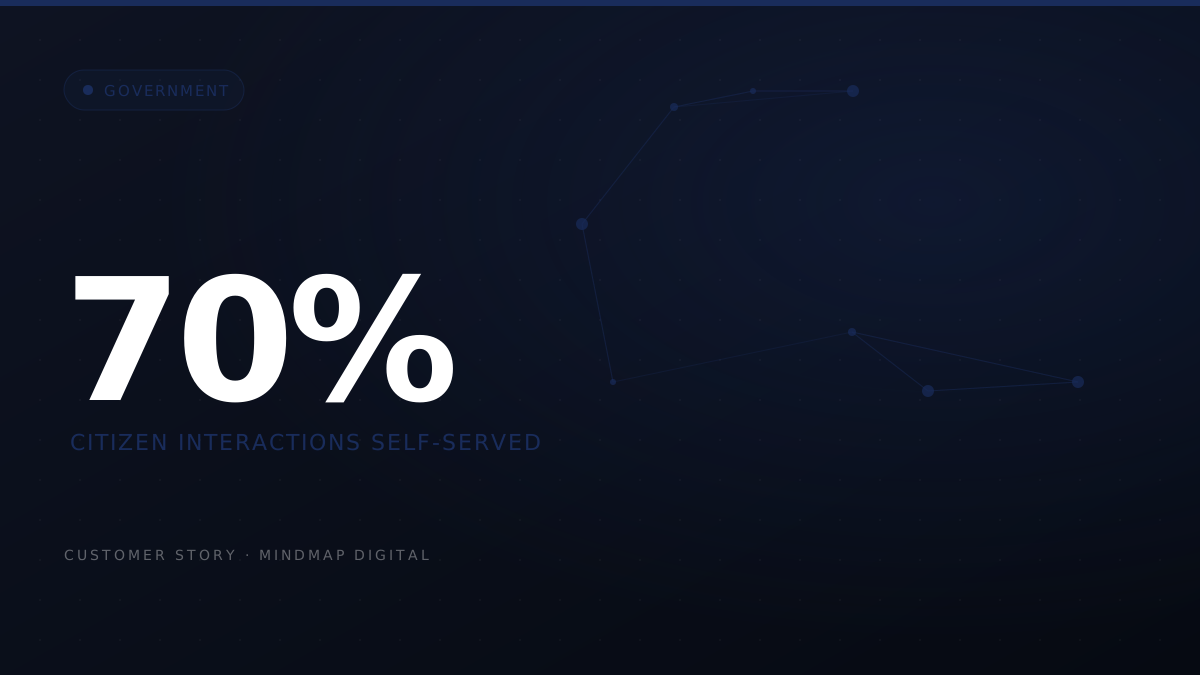
Approximately 70% of citizen-interaction volume across the 18 service domains is now handled by the platform without human intervention. The remaining 30% is either escalated to human agents (for the cases requiring human judgement) or routed to physical service-centre appointments (for the cases requiring in-person service).
Average citizen-service-completion time has dropped substantially across the service domains. Service transactions that previously required a physical service-centre visit (with the associated travel-and-wait-time burden on citizens) are now completing in minutes on the digital channels. The agency's citizen-experience metrics show material improvement.
Cross-domain service-experience has improved as a strategic outcome. Citizens experiencing multi-domain service needs (residency-and-vehicle, residency-and-business-licensing, residency-and-healthcare) can now complete the related transactions in a single conversation rather than navigating each service domain separately.
The physical service-centre and contact-centre operations have been resized. The freed capacity has been redirected to the complex-case handling, the exception-handling and the citizen-experience-improvement work that the previous transaction-volume had crowded out. Citizen-service-satisfaction in the human-channel interactions has improved as a result.
An unexpected outcome: the platform has become the agency's primary basis for cross-domain service-design improvement. The platform's interaction data has surfaced cross-domain friction patterns that the agency's previous domain-siloed analytics had not been able to identify, with the agency's policy-and-service-design team using the insights to drive several material cross-domain service-redesign initiatives.
“Our citizen-services transformation required digital-first delivery across eighteen service domains and seven languages, all on a sovereign on-premises deployment. MindMap delivered seventy per cent self-service across the service portfolio with the cross-domain experience our previous domain-siloed approach could not achieve. The platform has changed how our citizens experience government services.”— Director General· Gulf Government Agency
Why MindMap was chosen
The agency had evaluated several global government-services-technology vendors. The leading vendors required cloud-hosted deployments that the agency's data-handling posture did not permit. The previous in-house digital-services work had delivered domain-by-domain capability without the unified cross-domain experience the agency's leadership was seeking.
MindMap's accelerator-composition approach — bringing ChatNext, Policy Q&A Agent, Multi-Channel Agent, Sovereign LLM Platform and OnboardX together with the fully on-premises deployment and the cross-domain experience architecture — was the structural differentiator.
Our embedded public-sector expertise on the delivery team (two former government-services-transformation directors from peer Gulf-region governments and a multi-language-accessibility specialist) was the third factor. The agency's leadership felt that the team understood the public-sector and citizen-experience realities of government-services transformation.
Get the MindMap capability deck
The platform, the accelerator library and how an engagement runs, in one deck. Our team emails it within one business day.
Related deployments
African Tax Authority AI
An AI compliance-platform delivered 31% compliance-yield uplift across VAT, corporate tax and customs — at one of Africa's largest tax authorities.
Government Policy Intelligence
An LLM-powered policy-intelligence platform supporting cross-domain analysis across 14 policy domains — sovereign deployment, full provenance.
Large-Scale Skilling Partnerships
MindMap as preferred strategic-deployment partner for large-scale CSR-funded skilling activities with state-governments and corporate-donors — 6,400+ candidates upskilled across 11 cities, 9 Qualification Packs, 150,000+ training hours.
Want an outcome like this?
Start with a 2-week AI Readiness Sprint. We deliver a prioritised use-case backlog and business case grounded in what's actually buildable with our accelerator library.